


Ask anyone who rides the Corniche at 5:30am what they remember about their first month. It's usually the sun coming up over the water and hitting them square in the eyes, right as they turn back towards Sheraton Park.
That's the thing about cycling here. The light is brutal, the dust shows up without warning, and you're moving at 30 km/h into whatever the air is carrying that day.
Regular fashion sunglasses aren't really built for that. We sell a lot of sports sunglasses in Qatar to riders who learned this the hard way. So here's roughly what we tell them at the counter, including which lens suits the hour you actually ride.
The short answer: proper cycling glasses keep the sun, the wind and the grit out of your eyes, and they don't budge when you stand up on the pedals. Here, with the sun out nearly every day and the odd shamal turning the sky beige, we'd put them in the same category as your helmet. Get UV400, a lens that won't shatter, a frame that wraps round, and a tint picked for when you ride.
Can't you just ride in normal sunglasses?
You can. For about a week.
Then the problems turn up. Fashion frames slide down your nose as you sweat. They leave gaps at the sides, so wind gets in and your eyes stream on every descent off the Lusail bridges. And most of them were never designed to take a hit from a stone kicked up by a passing car.
Cycling glasses are shaped differently. They curve around the face, the arms grip without pinching, and the nose pads are usually rubber that gets tackier when it's wet. Small details. They matter at hour two of a ride.
What do cycling glasses actually protect you from?
More than people expect.
- UV rays. The UV index here goes very high to extreme for months at a time, and years of that without protection is one of the things eye doctors link to cataracts
- Glare. Off the tarmac, off the sea, off half the windows in West Bay
- Wind. Ride for an hour at speed and your eyes dry out, then sting, then go red
- Dust and sand. One shamal gust on the Dukhan road and you'll understand this one immediately
- Bugs and grit. Gravel flicked up by a truck tyre, or a fly at dawn that heads straight for your eye
There's a safety bit too. Squint into the sun and you spot that pothole maybe half a second later than you should, which at 30 km/h is about four metres of road.
What lens colour works best for cycling?
Depends when you ride, honestly. Nobody sensible rides at noon in July here, so most of our customers are out before sunrise or after dark, and that flips the usual advice.
Grey, for the sunny weekend ride
Good for full sun. They cut brightness without changing colours much, so traffic lights still look like traffic lights. Weekend riders heading out at ten or eleven tend to end up with grey.
Amber and rose, for hazy mornings
These boost contrast. Road texture, potholes and the edge of the tarmac stand out more, which helps in hazy, dusty conditions. A lot of riders here like them for the hours just after sunrise.
Clear or yellow lenses
For night rides and pre-dawn starts. You still get wind and debris protection without darkening anything. Riding without them at night is fine, right up until a moth finds your eye somewhere near Al Wakra.
Photochromic, if you hate carrying two pairs
They start out nearly clear and darken on their own as the sun comes up. Leave at 5, get home at 7 in full sun, and you've used one pair instead of two. One catch: in serious heat they're slower to change, and behind a car windscreen they barely change at all.
What about polarised lenses?
We like them, mostly.
Ride along the sea at 6am with polarised lenses and the glare off the water just disappears. But they can make some bike computer and phone screens look dim or patchy at certain angles. A few riders we know also find wet patches and oil harder to spot through them.
So if your Garmin or Wahoo matters to you, bring it into the store and look at it through the lenses first.
What we check when you're trying them on
When we fit cycling glasses, these are the questions we ask:
- Does the label actually say UV400, or 100% UVA and UVB?
- Polycarbonate lenses, or something else that won't shatter?
- Can wind still sneak in at the sides?
- Do they stay still when you shake your head or look down at your stem?
- Is there airflow, so they don't fog up the moment you stop at a red light?
- Can you swap the lenses?
Try them on with your helmet. Seriously. We've seen frames that look perfect in the mirror and then dig into the helmet straps ten minutes into a ride.
What if you wear prescription glasses?
This is where a lot of cyclists give up and just ride in their everyday glasses. Please don't.
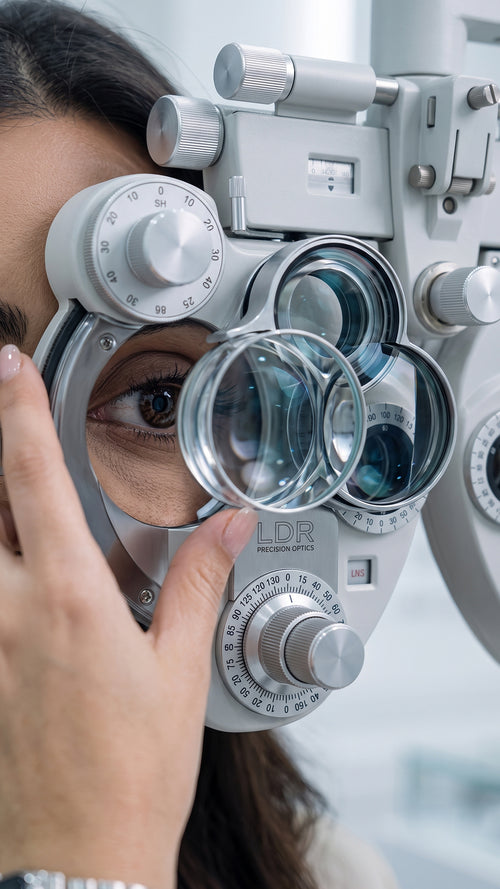
You have a few options. Prescription lenses can be made for many wraparound sports frames, though a very curved frame needs the prescription calculated carefully so your vision isn't distorted at the edges. Some sports frames take a small optical insert that sits behind the main lens. And contact lenses with regular sports sunglasses work well for plenty of riders, if your eyes cope with the dry air.
The right choice depends on your prescription strength and the frame shape. It's something a good optical store in Qatar should measure properly, not guess.
Do cycling glasses help you ride better?
They won't add watts, no. But they take away a lot of small distractions.
You stop squinting. Your eyes don't water. You're not pushing glasses back up your nose every few kilometres or wiping sand off your face. Five hours out to Al Zubarah and back, and none of that is nagging at you anymore.
Find the right pair for your ride
If we had to boil it down: protection, the right tint for your hours, and a frame that stays where you put it. After that you mostly forget you're wearing them, which is the point.
Come into Al Dar Optics with your helmet, and bring your bike computer too if you ride with one. Our team will help you pick sports sunglasses for cycling, check how they sit and sort out prescription lenses if you need them. Drop by or message us before your next ride.


