


Picture Reem. She's 27, works in West Bay, and has worn the same black frames since university. Her cousin's wedding is in three weeks and she's decided, finally, that she wants to try contacts.
She has no idea where to start. Neither do most people, honestly, and that's fine. We'll walk through her first few weeks, because the questions she runs into are the same ones we hear at our counters almost every day.
The short answer, if you're in a hurry: book an eye test and a fitting before anything else, because your glasses prescription won't cover it. Start with daily lenses. After that it's three rules. Water and lenses don't mix. You don't sleep in them unless you've been told yours are made for it. And a red, sore eye means the lens comes out, right then.
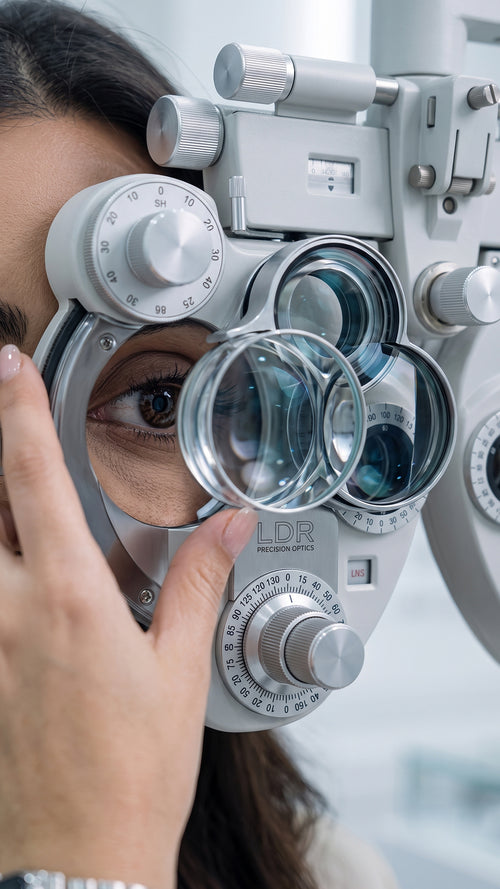
Do you need an eye test before buying contact lenses in Qatar?
Yes, and Reem was surprised by this too. She already knows her prescription, she points out, tapping her glasses.
Here's why that isn't enough. Think about where each one sits. Her glasses are about a centimetre away from her eyes. A contact lens sits right on the eye, so it has to follow its curve and be the right width, not just the right power. Get the numbers right and the fit wrong, and it feels like an eyelash you can't get out, all evening long.
Same rule for coloured lenses, by the way. Even a lens with zero power is still resting on your cornea.
Which type of contact lens is best for beginners?
For Reem, and for most first-timers, it's daily disposables. Fresh pair in the morning, in the bin at night. She never has to touch a lens case.
That matters more than it sounds. Most of the trouble beginners get into comes from the cleaning routine, the case left damp by the sink, the solution topped up "just this once". Dailies take all of that off the table.
There are other options, and the right one depends on your eyes and your week.
Daily disposables
This is what Reem went home with. Nothing to clean, nothing to store. They're handy if you only want lenses now and then too, like padel on a Thursday night or a wedding where glasses would end up in every single photo.
Two-weekly and monthly lenses
Her colleague at the next desk swears by monthlies. One box lasts him ages. He also admits he's fallen asleep without cleaning them more than once, and that's exactly the catch. With these, you clean them and store them in fresh solution every night. No skipping.
Toric lenses
Got astigmatism? Then regular lenses might leave the edges of things a bit soft. Toric lenses are shaped to fix that. You won't know if you need them until your eye-care professional checks.
Coloured lenses
Hazel eyes for the wedding, maybe? Fine, as long as they come from an optical shop and you've had a fitting first. Skip the cheap packs from online sellers nobody has ever heard of.
How do you put in contact lenses for the first time?
Reem's first attempt is at nine in the evening, in good light, with no rush. That was a smart choice.
She washes her hands with soap, dries them on a clean lint-free towel, and puts a lens on the tip of her index finger. Then she checks it from the side. It looks like a small bowl with the rim curving upwards, which means it's the right way round. (If the edge flares outwards like a saucer, it's inside out.)
She lifts her top lid with one hand and pulls the bottom lid down with the middle finger of the other. Looking straight ahead, she brings the lens towards her eye and sets it on gently.
Her eye blinks it straight back out. Twice.
On the third go it stays. She blinks slowly a few times, the lens settles, and suddenly the mirror is sharp without frames. If it had felt scratchy, the move would have been to take it out, rinse it in solution (not tap water, ever) and try again.
How do you take contact lenses out safely?
Clean, dry hands first. Reem looks up, pulls her lower lid down, and uses her index finger to slide the lens down onto the white of her eye. A gentle pinch between thumb and finger, and it's out. Dailies go straight in the bin. Reusable lenses go into the case with fresh solution.
On day two she panics because she "can't find" the lens. It can't actually go behind your eye. It had slid up under her top lid, and looking down while blinking a few times brought it right back.
What are the golden rules of contact lens care?
Reem got a short list on her first day, based on advice from the US Centers for Disease Control and Prevention (CDC) and the American Academy of Ophthalmology (AAO). She stuck it on her bathroom mirror. Not a bad idea.
-
Water stays away from lenses. Tap, shower, pool, sea, all of it. It can carry bugs that cause serious eye infections.
-
Lenses come out before bed, unless you've been told yours are made for overnight wear.
-
Fresh solution each time. No topping up the old stuff.
-
Reusable lenses get rubbed and rinsed, even with "no-rub" solution.
-
The case gets binned every three months at the latest.
-
Monthly means monthly. Day 40 is too late, however fine they feel.
Reem also learned to keep her glasses in her handbag. Around the second week, after a long day staring at spreadsheets, she was very glad she had.
How do contact lenses handle Qatar's weather and lifestyle?
Mostly well. There are a few local quirks, and Reem met all of them in her first month.
The first was the air conditioning. Her day goes from an air-conditioned flat to an air-conditioned car to a freezing office, then a mall after work. By late afternoon her lenses felt tight. Her eye-care professional suggested rewetting drops made specifically for contact lenses, which is very different from grabbing any bottle of eye drops off the pharmacy shelf.
Next came the dust. On a hazy, windy afternoon a bit of grit got under one lens and it stung. She took the lens out before touching her eye, which was exactly right. Rubbing with the lens still in just scrapes things around.
Then there was water. Her family went to Sealine for a weekend, and she left her lenses in the case for the beach. If you can't see much without correction, prescription goggles are worth asking about.
And sunglasses still matter here. Some lenses offer UV protection, but they only cover part of your eye.
When should you stop wearing your lenses and get help?
Noticing a new lens a bit in the first few days? Normal. Pain? Not normal, and it's worth taking seriously.
Lens out, and see an eye-care professional soon, if you get:
-
redness that hangs around
-
an eye that aches or hurts
-
light that suddenly feels too bright
-
blurriness that blinking won't clear
-
watering, or any discharge
The worst thing you can do is leave the lens in and hope. That's how a small problem turns into a miserable week.
How do you choose the best optical shop in Qatar for contact lenses?
Honestly? Watch how they treat you on the first visit. The best optical shop in Qatar for contact lenses is the one that remembers these go on your eye.
Reem walked out of one shop because they just handed her a box and pointed at the till. At the next one, someone asked about her prescription, sat with her until she'd got a lens in and out on her own, and talked her through cleaning for the exact lenses she was buying. They also made sure she left with the right solution and case.
Being close by helps too. The first couple of weeks are full of small questions, and a branch on your way home beats lying awake wondering.
Ready to try contact lenses?
Reem wore hers to the wedding. Nobody noticed the lenses. Plenty of people noticed she wasn't wearing glasses.
That's really how it goes for most people. Get the eye test done, pick the right lens, keep the routine simple enough that you'll actually follow it, and within a couple of weeks you stop thinking about it. If you're thinking about contact lenses in Qatar, come and see the team at Al Dar Optics. We'll help you choose lenses that suit your eyes and your routine, and show you exactly how to wear them and look after them.


