


Most people collect their prescription, hand it to whoever's at the counter, and trust the process. Which is mostly fine, right up until the glasses arrive and something's slightly off. Headaches by the afternoon. A faint sense that things aren't quite in focus even though the shop swore the prescription was filled correctly.
The prescription itself is rarely the problem. What happens with it is.
What's Actually on the Piece of Paper
A prescription is a set of instructions for building a lens, not a finished product, and reading it properly explains a lot about why two shops can produce noticeably different glasses from the exact same numbers.
OD and OS mean right eye and left eye respectively, from the Latin. Some prescriptions now use the plainer RE and LE instead.
SPH, short for sphere, is the main correction number. A minus sign means nearsighted, correcting for distance vision. A plus sign means farsighted, correcting for close-up vision. The number itself is measured in diopters, and the further from zero, the stronger the correction.
CYL, cylinder, appears if you have astigmatism, an irregularly shaped cornea rather than a perfectly round one. It's paired with an axis number between 1 and 180, which tells the lab exactly which orientation to grind the correction at. Get the axis wrong by even a few degrees and the lens can feel subtly wrong without being obviously wrong, which is often more frustrating than a lens that's clearly incorrect.
ADD shows up for anyone over the age where near vision starts declining, typically the mid-40s onward, and it's the additional magnifying power built into the bottom of progressive or bifocal lenses.
Prism, when present, corrects for eye alignment issues. It doesn't change how the glasses look, but it can add slightly to lens thickness.
None of this is complicated once it's explained. Almost nobody explains it, which is why most people never learn to actually read their own prescription.
The Measurement That Isn't Always on the Prescription
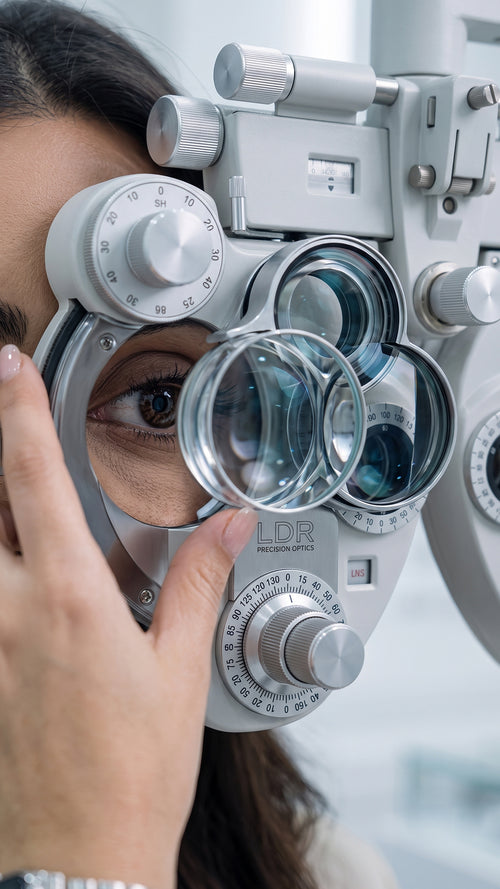
Pupillary distance, PD, is the space between the centres of your two pupils, measured in millimetres. It determines where the optical centre of each lens needs to sit so it lines up precisely with where you're actually looking through it.
Here's the part that surprises people: PD frequently isn't included on the prescription itself. It's not always a required field, and many optometrists leave it for the optician fitting the actual glasses to measure separately.
This matters more than the paperwork suggests. Average adult PD sits somewhere around 63mm, but the real range runs from roughly 51mm to 77mm depending on the person, and getting it wrong, even by a couple of millimetres, shifts the lens's optical centre away from where your eye actually is. For a simple prescription, a couple of millimetres rarely causes a problem. For a stronger prescription, particularly anything with meaningful cylinder correction, or for progressive lenses where vertical alignment matters as much as horizontal, an inaccurate PD is one of the more common reasons new glasses feel wrong even though the prescription was filled exactly as written.
If you've had trouble adapting to new glasses before, ask specifically whether your PD was measured individually rather than estimated from an average. It's a two-minute measurement and it removes one of the more common causes of that "something's not quite right" feeling.
Why the Same Prescription Can Produce Different Results
Two shops given the identical prescription can hand back two genuinely different pairs of glasses, and the difference usually isn't the accuracy of the numbers. It's everything around them.
Lens material and index. A stronger prescription in a standard-index lens comes out thick and heavy. The same prescription in a higher-index material is noticeably thinner and lighter, at a higher cost, but for anyone with SPH beyond roughly plus or minus 4.00, it's usually worth it.
Frame fit relative to your measured PD. A frame that sits slightly differently on your face than the one used during fitting changes where the optical centre needs to be. This is part of why a prescription copied to a different shop with a different frame occasionally needs a small adjustment rather than being a straight like-for-like transfer.
How CYL and axis get manufactured. Higher levels of astigmatism correction are more sensitive to precise axis alignment during grinding. A lab with tighter tolerances produces a more accurate result, and this is one of the genuine, if invisible, differences between a careful optical lab and a rushed one.
When a New Prescription Actually Needs New Glasses
Not every prescription change requires a new pair. A shift of 0.25 to 0.50 diopters is often small enough that most people don't notice a meaningful difference, particularly if the current glasses are otherwise comfortable.
Worth getting new lenses when the SPH or CYL changes by 0.75 or more, when the axis shifts meaningfully for anyone with astigmatism, when ADD power increases enough to affect near vision clearly, or when the old frame is genuinely worn out regardless of what the prescription says.
An eye exam finding no change at all is a good outcome, not a wasted visit. It confirms your correction is still accurate and that whatever's causing eye strain, if there is any, isn't a prescription problem at all.
Adapting to New Lenses
A period of adjustment is normal, particularly with a meaningful prescription change or a first pair of progressives. Mild dizziness, a sense that straight lines curve slightly at the edges, or minor headaches in the first few days are common and usually settle within a week or two as your visual system adapts.
What isn't normal: adjustment problems that persist well beyond two weeks, or genuine double vision. Either of those is worth going back to have checked, since it can point to a PD, axis, or fitting issue rather than something you simply need to get used to.
Getting It Right the First Time
The prescription is only ever half the story. The measurement, the material, the fit, and the manufacturing precision behind it are what actually determine whether those numbers turn into glasses that feel right.
Al Dar Optics measures PD individually for every customer rather than estimating from an average, and can talk through lens material and index options specifically suited to your prescription strength before you commit to a frame. With 11 branches across Qatar, adjustments and follow-up are straightforward wherever you are.
Bring your prescription in, or book an eye test if it's due for a refresh, and the team will walk through exactly what it means for your glasses.