


Most people in Qatar book an eye test for one of four reasons. The driving licence needs one. Work has started getting blurry by four in the afternoon. The kids' school sent a note home. Or the current glasses are two years old and something has clearly shifted.
Whichever brought you here, the search that follows tends to go the same way. You type eye test Doha into your phone, get a screen full of offers, and pick whichever looks cheapest or closest.
That is a reasonable way to buy sunglasses. It is a slightly odd way to buy a clinical examination.
An eye test in Qatar should be carried out by an optometrist licensed by the Ministry of Public Health, and should assess eye health rather than just measure your prescription. The offer attached to it matters far less than what the examination actually includes and who performs it.
What is actually happening during a proper eye test?
Two different things, and they often get confused.
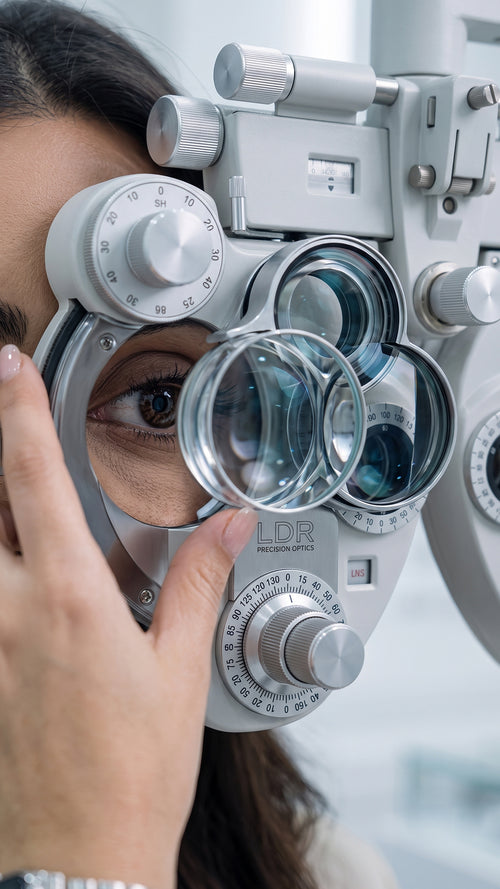
The first is refraction. That is the part everyone recognises, with the lenses clicking over and the question about whether one or two is clearer. It produces your prescription. It takes a few minutes and it is the part most heavily advertised, because it is the part that leads to selling you something.
The second is the health assessment. Eye pressure. The front structures of the eye. A look at the retina and optic nerve. Checks for early signs of conditions that have not yet produced symptoms you would notice.
That second half is the reason eye tests exist as a health service rather than a retail step. Glaucoma is the standard example, because it damages vision quietly and by the time most people perceive a problem, some of what has gone is not coming back.
Who is legally allowed to test your eyes in Qatar?
A licensed optometrist. Practitioners in Qatar are licensed through the Ministry of Public Health's Department of Healthcare Professions, and the process behind that licence is not a formality: recognised qualifications, verified credentials, a professional exam, documented clinical experience.
It is worth knowing the boundary of the role too. Optometrists in Qatar perform comprehensive eye examinations, prescribe corrective lenses, fit contact lenses, and take part in diabetic eye screening. Prescribing therapeutic eye medication sits with ophthalmology, so a good optometrist refers onward when something needs medical treatment rather than correction.
So the single most useful question you can ask an optical shop is also the least commonly asked one. Who will be performing the examination, and are they licensed?
Any shop worth visiting will answer that immediately and without irritation.
Why does this matter more in Qatar than in some other countries?
Diabetes. The Qatar Diabetes Association advises yearly eye screening for people living with diabetes, as an early preventive measure, and names retinopathy, glaucoma and cataracts among the conditions at stake. Retinopathy in particular tends to develop without early symptoms.
That single fact reshapes what a good optical shop looks like here. It is not the one with the widest frame wall. It is the one equipped and staffed to look properly at the back of your eye, keep records year on year, and refer you when something needs a doctor.
If you or anyone in your family has diabetes, this moves from a nice-to-have to the main criterion.
How do you judge an optical shop before you commit?
Six things, all of which you can establish before or during your first visit.
- Who tests you. A licensed optometrist, not a sales assistant running an autorefractor.
- How long the test takes. A full examination is not a five-minute exercise. If you are in and out of the testing room in that time, you had a refraction, not an eye test.
- What equipment is in the room. Ask whether retinal imaging and eye pressure testing are included, and whether they are part of the standard examination or an extra.
- Whether they keep your records. Year-on-year comparison is how slow changes get caught. A shop that cannot retrieve your last visit cannot do that.
- Whether they refer. A practice that has never sent anybody to an ophthalmologist is not being careful.
- What happens afterwards. Adjustments, fitting problems, a lens that is not working for you. Aftercare is where the difference between shops actually shows up, several weeks after the sale.
Notice that none of those are about the offer.
So what about the offers?
Offers are normal and there is nothing wrong with them. The question is only ever what sits inside them.
Read what the package actually includes. Some cover the full examination. Some cover a refraction only, with the health checks positioned as an add-on that never quite gets mentioned until you are in the chair. Some are structured around frames, where the test is essentially a route into the purchase.
Then look at what comes with the lenses rather than what is written on the front of the deal. Coatings, warranty terms, whether adjustments are included, what happens if your prescription needs remaking within a few weeks. Those terms decide whether a package is good value long after the headline has done its job.
A genuinely good offer survives that reading. Plenty do not.
How often should you actually get tested?
For most adults with no symptoms and no risk factors, every two years is the usual guidance. Annually for anyone over about sixty, for children once they are in school, and for anyone with an existing eye condition or a family history of one.
For people with diabetes, yearly, per the Qatar Diabetes Association.
Sooner than any of that if something changes. Persistent headaches, difficulty with night driving, eye strain that arrives every afternoon, sudden blurring, floaters or flashes. Sudden changes in vision are not a wait-and-see situation, and they belong with a doctor rather than a booking form.
Book the examination, then choose the glasses
The order matters more than people expect. Choose the practice on the quality of the examination and the person performing it, and treat the frames, the lenses and whatever offer is running as a separate decision that comes afterwards.
Get that sequence right and the worst case is you pay slightly more for a pair of glasses. Get it backwards and the worst case is something treatable going unnoticed for two years.
Al Dar Optics runs full eye examinations in Qatar with licensed optometrists, including the health checks that a quick refraction skips, along with frames, lenses and aftercare under one roof.
Book an eye test with Al Dar Optics and get the whole examination, not half of it.